
A minimalist wallet is not a small wallet. It is a wallet sized to what you actually carry, with nothing left over to fill. That distinction matters because the market sells "minimalist" as a look, and a twelve-card metal case is not minimalist just because it is rectangular. This guide defines the term properly, sets out the five formats that qualify and who each one suits, explains how to count your cards honestly before you buy, and names the best minimalist wallets of 2026 by type, including the ones we do not make. For measured weights and thicknesses across models, our slim wallet comparison has the numbers; this article is about choosing the right kind in the first place.

The short answer
Count the cards you have used in the last month, not the ones you own. For most men that is three to five. If it is three and you never carry cash, buy a card sleeve or a cardholder. If it is four or five and you carry some cash, buy a slim vertical bifold for the front pocket. If you want a hard case around the cards, buy a plate or aluminium wallet and accept that it will not fold or hold bills properly. Whatever the format, choose a material that does not stretch, because a minimalist wallet that grows is a thick wallet with fewer pockets.
What "minimalist wallet" actually means
Three things, and a wallet needs all of them. First, capacity matched to use: room for the cards you carry, not a slot count to impress. Second, a profile that stays the same loaded as it was in the photo, which rules out soft leathers that swell and any design that relies on an elastic band to hold its shape. Third, nothing that does not earn its place: no coin purse you never open, no ID window if your ID lives in a card slot, no bill section if your money is a phone.
By that definition a minimalist wallet can be leather or carbon fiber, soft or rigid, 20 grams or 50. What it cannot be is a wallet you grow into. The habit it rewards is the audit: once a year, take everything out and put back only what you used. We wrote about that audit in What to Keep in Your Wallet.
The five minimalist wallet formats
1. Card sleeve
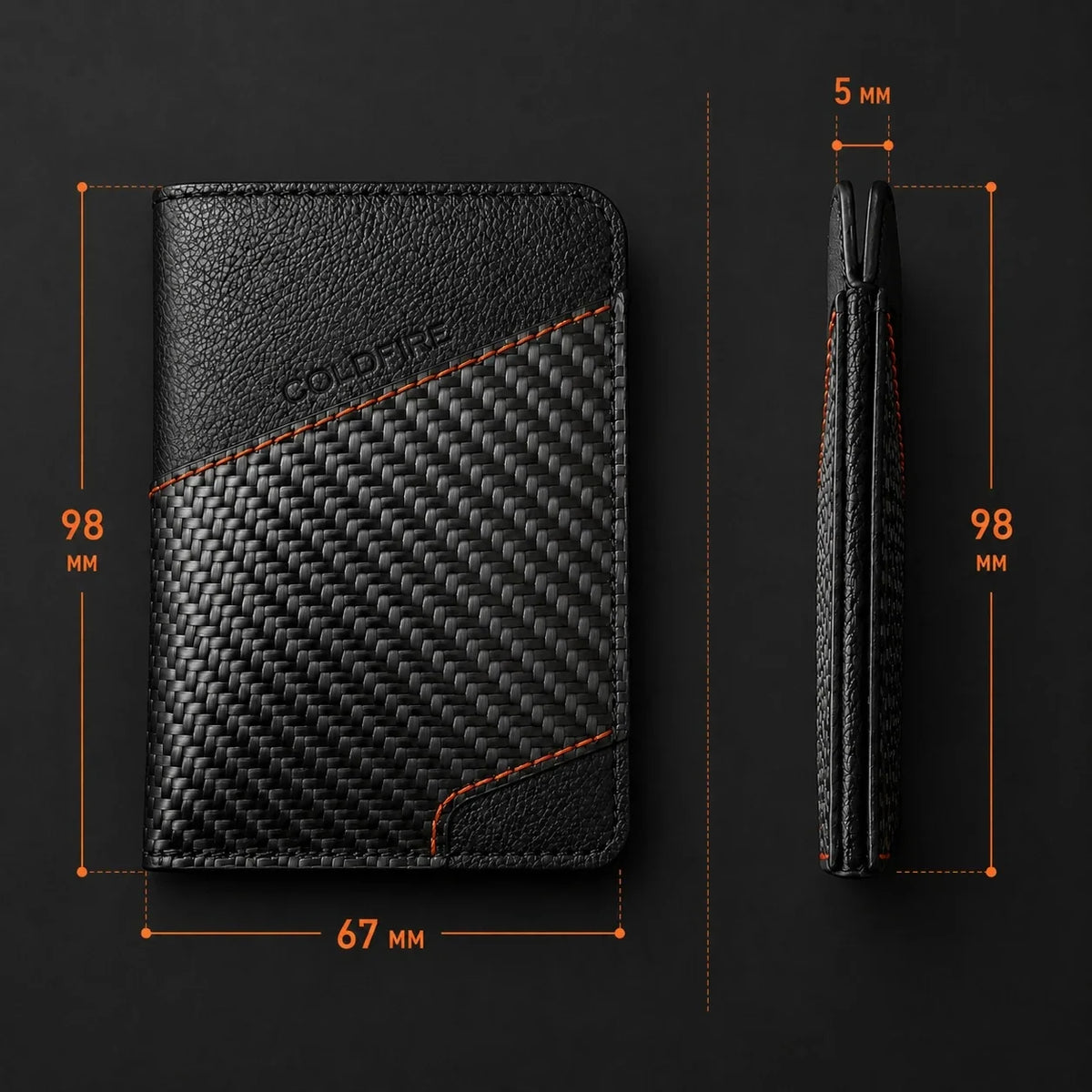
A single pocket, or two, that the cards slide into as a stack. The lightest format there is, often under 25 grams. Access is by pushing the stack up with a thumb or pulling a tab. Best for two to five cards and nothing else; a folded note will fit behind the cards in most sleeves but it is not the point. In soft leather a sleeve loosens within a year because the whole wallet is one stretched pocket; in kangaroo leather or a composite it holds. Our Scout One is this format: 25 grams, 5 mm, four to five cards, a flexible carbon fiber spine with kangaroo leather, RFID shielded.
2. Cardholder with slots
Flat, unfolded, with two or three slots on each face and sometimes a central pocket. Cards are separated, so the one you tap is always on the outside. Slightly heavier than a sleeve, usually 20 to 45 grams, and still thin enough for a shirt pocket. Best for three to six cards and a folded note. This is where most "minimalist leather wallet" searches end up, and it is the format where leather quality decides everything, because every slot is a stretch point. Our cardholders, including the Flex Air (42 grams, 5 mm, three cards and an ID window) and the Stealth (20 grams), sit here.
3. Slim vertical bifold
A bifold turned ninety degrees so it is narrow and tall, built for the front pocket. It folds, so it carries bills unfolded or folded once, and it holds four to six cards in slots. Weighs 40 to 60 grams when built well, 5 to 8 mm closed. This is the minimalist format for people who still use cash or want a bill compartment for receipts. The Flex One (46 grams, 5.5 mm, four cards plus bills) and Flex Ultra (58 grams, five cards, ID window and bills) are ours in this format, and the reason we build them vertical is explained in the Flex series notes.
4. Plate and aluminium wallets
Two rigid plates, or a machined case, holding cards by an elastic band, a spring or a lever. Rigid protection, a very small footprint, and a strong following. They do not fold, they hold cash only under an outside strap or clip, and the band or mechanism is a wear part. Best for people who want a hard shell and carry cards only. The Ridge, Secrid's Cardprotector and Ekster's cases are the well-known examples, compared honestly in Best Ridge Wallet Alternatives and in Metal Wallets vs Flexible Carbon Fiber.
5. Phone-attached wallets
A MagSafe or adhesive pocket on the back of the phone for two or three cards. The ultimate reduction, with one obvious condition: if the phone goes, the cards go. Good for a second set of cards or for people who want to leave the house with one object. PITAKA's MagEZ is the best-made example we know.
| Format | Cards | Cash | Typical weight | Fails by | Who it suits |
|---|---|---|---|---|---|
| Card sleeve | 2 to 5 | A folded note at most | 15 to 30 g | Pocket stretching (soft leather) | Cards-only, lightest possible |
| Cardholder with slots | 3 to 6 | Folded, in a central pocket | 20 to 45 g | Slots stretching | Cards plus occasional cash, shirt pocket |
| Slim vertical bifold | 4 to 6 | Yes, bill compartment | 40 to 60 g | Fold fatigue, slot stretch | Front pocket, still uses cash |
| Plate or aluminium | 1 to 12 | Outside clip or strap | 45 to 90 g | Elastic or mechanism wear | Hard shell, cards only |
| Phone-attached | 2 to 3 | No | 20 to 40 g | Magnet or adhesive letting go | One-object carry |
How many cards do you really carry?
This is the whole decision, so do it properly. Empty your current wallet and sort the cards into three piles: used this week, used this month, not used since you can remember. The first pile is your capacity. The second pile goes in the wallet only if there is a slot spare; otherwise it lives in a drawer or a phone wallet. The third pile is the reason your wallet is thick, and it does not come back.
Most men end up with one payment card, one backup, an ID or licence, a transit or access card and perhaps one loyalty card, which is four or five. Buy for that number. A wallet with twice the capacity will be filled, because empty slots are an invitation, and then it is not minimalist any more.

Materials: why minimalist wallets fail differently
A full-size wallet can hide a little stretch. A minimalist wallet cannot, because every millimetre of growth is visible and every loosened slot drops a card. That changes which materials work.
Soft cowhide, especially top-grain and anything sold as "genuine leather", stretches at the slots and swells at the fold, and in a minimalist wallet that happens faster because the leather is thinner to start with. Full-grain cowhide stretches less but needs to be cut thick, which defeats the slimness. Kangaroo leather is the leather that solves this: at 0.5 to 0.7 mm it holds a card slot's width where cowhide needs twice the thickness, which is why we use it, and why we set out the figures in Kangaroo Leather vs Cowhide. Flexible carbon fiber does not stretch at all; it is the structural answer, and the reason a Flex One closed at 5.5 mm in year one closes at 5.5 mm in year five, within its stated capacity. Rigid plates and aluminium never stretch either, but they move the wear to the elastic. Fabric wallets are light and cheap and fray at the pocket mouth unless the lining is a ripstop with sealed edges. The full ranking by strength is in What Is the Strongest Wallet Material?, and by lifespan in How Long Does a Wallet Last.
Best minimalist wallets of 2026, by format
One pick per format, with the honest alternative next to it. We make three of the five; the other two we do not sell and do not profit from. Measured weights and thicknesses for the models we have on the bench are in the slim wallet comparison.
Best card sleeve: COLDFIRE Scout One
25 grams, 5 mm, four to five cards, RFID shielded, a flexible carbon fiber spine under kangaroo leather, with a kangaroo-lined interior and no metal. The least wallet that still has structure. Alternative: Bellroy's Card Sleeve, in leather with a pull tab, if you want a traditional look and accept that leather sleeves loosen.
Best cardholder: COLDFIRE Flex Air
42 grams, 5 mm closed, three card slots, two slip pockets and an ID window, carbon fiber and kangaroo leather, titanium plate, RFID Data Armor. Alternative: Secrid's Cardprotector, if you want cards inside an aluminium case with a lever, at roughly the same weight but without a fold or an ID window.
Best slim bifold: COLDFIRE Flex One
46 grams, 5.5 mm closed, four cards plus two slip pockets and a bill compartment that takes euro notes unfolded, Gear43's Best Unique Bifold in its 2026 awards after testing more than 150 wallets. Alternative: Bellroy's Note Sleeve, in leather, if you prefer a horizontal fold and are happy to let it age.
Best plate wallet: The Ridge (aluminium)
Not ours, and the right answer if a hard shell is what you want: two plates, an elastic strap, up to twelve cards, a lifetime warranty and replacement straps sold openly. Buy the aluminium version, carry a spare strap, and keep cash out of it. The reasons people move on from it are in Best Ridge Wallet Alternatives.
Best phone wallet: PITAKA MagEZ
Not ours. A MagSafe module in aramid fiber with a carbon layer to protect the cards from the magnets, two or three cards, beautifully finished. Buy it as the second set of cards, not the only one.
- Scout One
- Card sleeve. 25 g, 5 mm, 4 to 5 cards. Carbitex OmniFlex spine, kangaroo leather, RFID. No metal.
- Flex Air
- Cardholder. 42 g, 5 mm closed, 3 cards + ID window + 2 slip pockets. Carbon fiber, kangaroo leather, titanium, RFID Data Armor.
- Flex One
- Slim vertical bifold. 46 g, 5.5 mm closed, 4 cards + 2 slip pockets + bills. Carbon fiber, kangaroo leather, titanium, Dyneema lining, RFID Data Armor.
- All three
- Handcrafted in Plovdiv, Bulgaria. Five-year warranty against stretching and loss of shape within stated capacity.
The three COLDFIRE formats are in the slim wallets collection, and every material is named with its maker on the Engineering and Quality page.
Five mistakes that turn a minimalist wallet into a normal one
- Buying capacity you do not use. Twelve slots will be filled. Buy for the cards from last week.
- Trusting the empty thickness. Ask for the loaded number, or measure it. A wallet that doubles when loaded is not slim.
- Soft leather in a thin wallet. It stretches faster than in a thick one. Full-grain, kangaroo or a composite, or expect to replace it.
- Keeping cash outside. A money clip on the back of a plate wallet is money you will drop. If you use cash weekly, buy a format with a bill compartment.
- Carrying the old wallet "for now". Two wallets is the opposite of minimalist. Move the cards on day one and put the old one away.
Minimalist wallet questions, answered
What is a minimalist wallet?
A wallet sized to the cards and cash you actually carry, usually three to six cards, with a profile that stays the same loaded as empty and no features you do not use. It can be a card sleeve, a cardholder, a slim bifold, a plate wallet or a phone-attached pocket; the format matters less than the match between capacity and use.
How many cards should a minimalist wallet hold?
The number you used in the last month, which for most men is three to five: a payment card, a backup, an ID, a transit or access card and perhaps one more. Buy for that number rather than the maximum, because empty slots get filled.
What is the best minimalist wallet for men?
It depends on cash. For cards only, a sleeve or cardholder at 20 to 45 grams: the COLDFIRE Scout One or Flex Air, or a Secrid Cardprotector if you want an aluminium case. For cards and bills, a slim vertical bifold such as the Flex One. For a hard shell, the Ridge in aluminium with a spare strap.
Are minimalist wallets practical?
Yes, if you do the card audit first. The people who find them impractical are usually trying to fit the contents of a full wallet into a small one. Sized correctly, a minimalist wallet is faster to use than a full one because the card you need is always one of four, not one of twelve.
Leather or carbon fiber for a minimalist wallet?
Carbon fiber, or kangaroo leather, if you want the wallet to stay the thickness you bought it at; these do not stretch under card pressure. Full-grain cowhide if you want a traditional leather that ages, accepting that slots loosen over years. Avoid soft or split cowhide in any thin wallet.
Do minimalist wallets have RFID blocking?
Some do. It is worth having when it adds no thickness, mainly for card clash at transit gates and for weakly protected access cards, and all COLDFIRE wallets include it. It is not what stands between you and card fraud; the honest account is in Do You Need an RFID Wallet?.
Written by Todor Georgiev, founder of COLDFIRE and a leather goods manufacturer in Plovdiv since 2000. Published 3 November 2026. COLDFIRE figures are workshop measurements; the Ridge, Bellroy, Secrid and PITAKA are described from their published specifications and our own use, and COLDFIRE has no commercial relationship with them.

Share:
Passport Holder vs Travel Wallet: Which One to Carry, and Does It Need RFID?